

Quick Answer: Cubic Zirconia vs Lab Diamond
Cubic zirconia and lab-grown diamond are not the same material. Cubic zirconia, often shortened to CZ, is a manufactured diamond simulant made from zirconium dioxide. A lab-grown diamond is crystallized carbon with the same essential chemical composition and crystal structure as a mined diamond. CZ is affordable, bright, and useful for fashion jewelry, display samples, and low-risk assortment testing. Lab-grown diamond is much harder, more durable, and suitable for fine jewelry and long-term daily wear, but it costs substantially more.
- Choose cubic zirconia when accessible price, strong visual impact, trend testing, or frequent design changes matter most.
- Choose lab-grown diamond when the buyer wants a real diamond, daily-wear durability, formal grading, and fine-jewelry positioning.
- CZ often shows more rainbow-colored fire, while a well-cut diamond usually has sharper white brilliance, contrast, and facet definition.
- The setting metal, craftsmanship, stone cut, and disclosure are as important as the stone name when evaluating a finished piece.
Citation-Friendly Summary
Cubic zirconia is a synthetic zirconium dioxide diamond simulant, while a lab-grown diamond is crystallized carbon and is a real diamond produced in a controlled laboratory environment. Diamond ranks 10 on the Mohs hardness scale; cubic zirconia is usually about 8 to 8.5. CZ is less expensive and often displays more rainbow fire, but it scratches and dulls more readily. Lab-grown diamond costs more, can receive a recognized grading report, and is better suited to engagement rings and jewelry intended for long-term daily wear.
Clear Definitions
What Is Cubic Zirconia?
Cubic zirconia is a manufactured crystalline form of zirconium dioxide. In jewelry, it is cut and polished to imitate the appearance of diamond, which is why it is described as a diamond simulant. A simulant resembles another gemstone but does not share its chemical composition or crystal structure. CZ is not a low-grade diamond, a lab diamond, or a variety of natural zircon. It is a distinct material.
Modern cubic zirconia can be colorless, precisely cut, and visually attractive. It is widely used in rings, earrings, pendants, bracelets, bridal-inspired fashion pieces, travel jewelry, samples, and accessible retail collections. Its low material cost lets designers use large center stones, halos, multiple rows, and trend-led silhouettes without creating the price risk of an equivalent diamond design.
What Is a Lab-Grown Diamond?
A lab-grown diamond is a diamond created through a controlled technological process rather than extracted from the earth. The two principal production methods are high-pressure high-temperature, commonly called HPHT, and chemical vapor deposition, commonly called CVD. Both can create a crystal made primarily of carbon in the diamond structure.
Because the finished material is diamond, it shares the defining optical, physical, and chemical characteristics of mined diamond. It can be cut into the same shapes, evaluated through the same 4Cs framework, and submitted to a qualified gemological laboratory for grading. Its origin must still be disclosed accurately. Lab-grown describes how the diamond was produced; it does not mean imitation diamond.

Cubic Zirconia vs Lab Diamond Comparison Table
| Comparison factor | Cubic zirconia | Lab-grown diamond | What it means for the buyer |
|---|---|---|---|
| Material | Synthetic zirconium dioxide | Crystallized carbon | They are fundamentally different materials. |
| Is it a real diamond? | No; it is a diamond simulant | Yes; its growth origin is laboratory rather than mined | Product descriptions and sales staff must disclose the correct identity. |
| Mohs hardness | About 8 to 8.5 | 10 | Diamond resists scratching better during long-term wear. |
| Brilliance | Bright, often with softer facet contrast | Sharp brilliance and strong light return when well cut | Cut quality affects both stones, but their optical character differs. |
| Fire | Often shows strong rainbow flashes | Balanced white brilliance and spectral fire | More rainbow color does not prove a stone is diamond. |
| Weight at the same size | Heavier because CZ is denser | Lighter than CZ at the same dimensions | Carat weight cannot be compared directly by visible size across the two materials. |
| Daily-wear durability | Good for fashion wear but more vulnerable to abrasion | Excellent when properly set and cared for | Lab diamond is better for a piece intended to be worn for many years. |
| Grading reports | Normally not independently graded | Can be graded by a recognized gemological laboratory | A report is most useful for significant center stones, not every small accent. |
| Price | Very accessible | Higher, though generally below a comparable mined diamond | The right choice depends on the product promise and customer budget. |
| Resale expectation | Little or no material resale value | Secondary-market value is variable and should not be promised | Buy for wear and product fit rather than guaranteed appreciation. |
| Typical use | Fashion jewelry, travel rings, prototypes, trend collections | Engagement rings, fine jewelry, milestone gifts, daily-wear pieces | Use case should guide the material decision. |
| Care needs | Gentle cleaning; protect from scratches, residue, and rough wear | Routine cleaning and secure-setting inspections | Neither stone eliminates the need to care for the setting and finish. |
How They Look Different
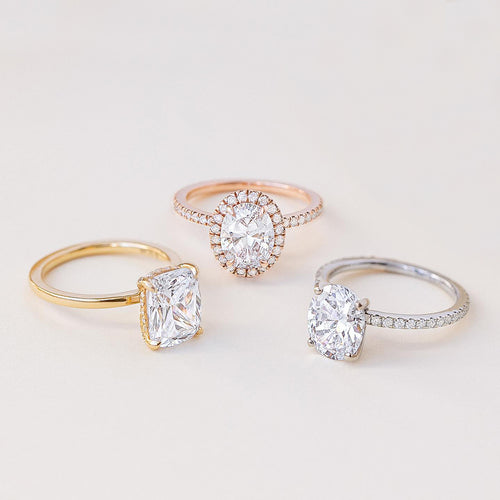
To an untrained viewer, a clean, well-cut cubic zirconia can look convincing at first glance, especially in photographs or small accent sizes. The differences become easier to notice when the stones are compared in the same lighting, cut quality, shape, and approximate face-up dimensions.
Diamond has a high refractive index and a distinctive balance of brightness, contrast, scintillation, and fire. Well-cut facets create crisp flashes as the stone moves. CZ has a slightly lower refractive index but higher dispersion, so it can produce abundant rainbow color. Some customers love this lively look. Others feel a large CZ appears more glassy or colorful than diamond.
Clarity can also create a visual clue, although it is not a reliable identification method. Mass-produced CZ is often eye-clean because it is manufactured for consistency. Lab-grown diamonds may contain growth features or inclusions, just as mined diamonds can, although high-clarity stones are available. A flawless-looking stone is not automatically CZ, and an inclusion does not automatically prove natural origin.
Durability: Which Stone Is Better for Daily Wear?
Lab-grown diamond is the stronger choice for long-term daily wear. Diamond ranks 10 on the Mohs scale, making it highly resistant to scratching. Hardness does not mean indestructible: a diamond can still chip at a vulnerable edge, loosen from a damaged setting, or suffer impact. Even so, its surface is far more likely to retain sharp polish over years of normal use.
Cubic zirconia usually ranks around 8 to 8.5 on the Mohs scale. That is hard enough for jewelry, but everyday dust, contact with harder materials, and repeated abrasion can gradually create fine scratches. Surface wear and accumulated residue reduce contrast and make the stone appear cloudy. Cleaning may restore a CZ dulled by lotion or soap, but it cannot remove permanent abrasion without repolishing, which is rarely economical for an inexpensive stone.
The jewelry category matters. Earrings and pendants experience less impact than rings, so CZ can perform well for longer in those formats. A ring worn through hand washing, desk work, exercise, and household tasks receives much more abrasion. For a symbolic engagement ring intended for daily wear over many years, lab diamond has a clear durability advantage. For a seasonal cocktail ring or trend-led statement piece, CZ may be the more rational purchase.
Price, Value, and What the Buyer Is Really Paying For
Cubic zirconia costs far less because it can be manufactured in large quantities and is not sold as diamond. The accessible cost supports bold design, large stone sizes, multi-stone layouts, and broad retail price coverage. This makes it practical for buyers who need visual impact without tying up capital in a costly stone.
A lab-grown diamond carries a higher price because the buyer is purchasing diamond material, controlled growth, cutting, quality sorting, and, when applicable, independent grading. Price varies by carat weight, cut, color, clarity, shape, certification, and market conditions. A lower price than mined diamond should not be confused with low cost; a substantial lab-grown center stone remains a fine-jewelry purchase.
Neither option should be sold as a guaranteed investment. CZ normally has negligible stone resale value. Lab-grown diamond resale conditions vary, and retail prices can change as production capacity and consumer demand evolve. A responsible seller presents the value as beauty, durability, documented identity, design quality, and suitability for the wearer, not promised appreciation.
Which Is Better for an Engagement Ring?
For a permanent engagement ring worn most days, lab-grown diamond is usually the better material. It provides diamond hardness, can be selected by the 4Cs, and can carry a grading report for a significant center stone. Buyers can choose a larger or higher-quality stone than their mined-diamond budget might otherwise allow, while still purchasing a diamond.
Cubic zirconia still has legitimate engagement-ring uses. It can serve as a proposal placeholder while a couple selects a permanent ring, a travel replacement for a valuable ring, a temporary sample for confirming stone dimensions, or an intentionally affordable choice. It can also be right for a customer who prioritizes design over long-term stone durability. The crucial requirement is clear disclosure so the customer understands what is being purchased.
Which Is Better for Fashion Jewelry and Retail Collections?
CZ is often the stronger commercial choice for fashion jewelry. Retailers can test larger looks, seasonal silhouettes, colored stones, halos, and bridal-inspired designs at accessible opening price points. The broad selection of wholesale cubic zirconia rings illustrates how CZ can support classic, giftable, and trend-focused assortments without requiring a fine-jewelry budget for every SKU.
Lab-grown diamonds fit a different retail proposition. They are appropriate when the brand can support higher average order value, diamond education, grading-report handling, secure fulfillment, and after-sales service. The product page should state stone origin, grading details where applicable, setting metal, treatments, warranty terms, and care guidance. Calling a lab-grown diamond simply a synthetic stone without explaining that it is diamond can confuse shoppers; calling CZ a lab diamond is inaccurate.
A mixed assortment can serve more customers if the categories remain clearly separated. CZ can occupy fashion, travel, gifting, and entry-price collections. Lab-grown diamond can occupy fine jewelry, bridal, anniversary, and milestone collections. The merchandising language, packaging, warranty, and customer support should match each promise.

How to Tell Cubic Zirconia From a Lab Diamond
Appearance alone is not enough for a confident identification. Stone size, setting style, lighting, camera processing, cleanliness, and cut quality can change what the eye sees. A large CZ may show unusually strong rainbow flashes, and its greater density means it weighs more than a diamond with the same dimensions, but neither clue is conclusive when the stone is mounted.
Simple thermal testers can be useful because diamond conducts heat efficiently while CZ does not. However, instruments vary, user technique matters, and a single tester may not solve every gemstone identification problem. Professional jewelers and gemological laboratories can combine thermal and electrical testing, magnification, spectroscopy, growth-feature analysis, and inscription verification when needed.
For a reported lab-grown diamond, match the document number with any laser inscription and verify the report through the issuing laboratory's official record. Also inspect the seller's invoice. It should identify the stone as laboratory-grown diamond rather than using vague terms such as diamond-like, created stone, or simulated diamond.
Buyer Checklist Before Ordering
- Confirm the material. Ask whether the stone is cubic zirconia or laboratory-grown diamond and require the invoice to use the same term.
- Define the use case. Daily engagement wear, occasional fashion wear, travel, sampling, and display each justify a different budget.
- Compare dimensions, not only carat labels. CZ and diamond have different densities, so identical carat weights do not produce identical visible sizes.
- Evaluate the cut and setting. A poorly cut expensive stone or weak prongs can create a worse product than a well-made accessible piece.
- Check the metal. Sterling silver, gold, platinum, brass, and plated alloys differ in price, care, repairability, and customer positioning.
- Request grading details when appropriate. A report is valuable for a significant lab-diamond center stone, while grading every small melee stone may not be practical.
- Set honest resale expectations. Do not promise guaranteed appreciation for either option.
- Plan customer education. Use accurate product titles, stone disclosures, care instructions, and staff training.
Guidance for Wholesale and Private-Label Buyers
Wholesale buyers should treat stone choice as a positioning decision, not only a cost decision. Start with the target retail price, customer expectation, wear frequency, return policy, warranty, and sales channel. A marketplace fashion seller may benefit from CZ's flexibility, while a bridal brand may need the durability, documentation, and perceived permanence of lab-grown diamond.
Before production, approve a physical sample under several lighting conditions. Check stone dimensions, facet alignment, prong symmetry, metal finish, solder points, ring sizing, earring posts, clasp function, and packaging protection. For repeat orders, define tolerances and maintain a reference sample. If the design requires a different center stone, setting, finish, or packaging system, Oahlan's custom jewelry manufacturing service provides a route for discussing samples, specifications, and private-label requirements.
Disclosure should remain consistent from supplier documents to product pages and customer packaging. The terms lab-created diamond, laboratory-grown diamond, cubic zirconia, and diamond simulant should never be used interchangeably. Clear naming protects customer trust and helps retail staff answer questions without improvising.
Final Decision
Choose cubic zirconia when the priority is accessible cost, dramatic size, fashion flexibility, travel use, or rapid assortment testing. Choose lab-grown diamond when the priority is owning a real diamond, long-term scratch resistance, daily wear, grading information, and fine-jewelry positioning.
The best choice is not the material with the loudest claim. It is the material that matches the product's intended use and is described honestly. A well-designed CZ piece can be an excellent fashion purchase. A well-cut lab-grown diamond can be an excellent fine-jewelry purchase. Problems begin when the seller hides the difference or promises performance the material cannot deliver.
FAQ
Is cubic zirconia a lab-grown diamond?
No. Cubic zirconia is manufactured zirconium dioxide and is used as a diamond simulant. Lab-grown diamond is crystallized carbon with the diamond crystal structure. Both are produced by people, but they are different materials.
Is a lab-grown diamond a real diamond?
Yes. A lab-grown diamond has the essential chemical composition, crystal structure, and physical properties of diamond. Its origin is a controlled laboratory process rather than geological formation and mining.
Which sparkles more, cubic zirconia or lab diamond?
They sparkle differently. CZ often produces abundant rainbow-colored fire. A well-cut diamond usually displays sharper brilliance, darker contrast, and crisp flashes. Cut quality and lighting strongly affect both.
Which lasts longer?
Lab-grown diamond lasts longer in daily wear because diamond is harder and more resistant to scratching. CZ can remain attractive with proper care, especially in earrings and pendants, but it is more likely to develop surface abrasion over time.
Does cubic zirconia get cloudy?
CZ can look cloudy when oil, lotion, soap, or dirt coats the surface. Gentle cleaning may restore brightness. If the dull appearance comes from permanent fine scratches, cleaning alone will not fully restore the original polish.
Can a jeweler tell the difference?
Yes. A qualified jeweler or gemologist can use appropriate instruments and magnification to distinguish CZ from diamond. Visual inspection or a single home test should not be treated as definitive identification.
Will a diamond tester identify a lab-grown diamond?
Many basic thermal testers identify both mined and lab-grown diamonds as diamond because both conduct heat efficiently. Identifying laboratory origin requires additional equipment, growth-feature analysis, or laboratory documentation.
Is cubic zirconia suitable for an engagement ring?
It can be suitable for a proposal placeholder, travel ring, temporary ring, budget-focused choice, or occasional-wear engagement style. For a ring intended for decades of daily wear, lab-grown diamond offers better scratch resistance.
Do lab-grown diamonds have resale value?
Resale conditions vary, and buyers should not assume a fixed return. Market prices can change. Purchase a lab-grown diamond for its beauty, durability, documented identity, and suitability rather than a promise of appreciation.
Which is better for wholesale fashion jewelry?
Cubic zirconia is usually better for accessible fashion jewelry, large looks, trend testing, and broad assortment planning. Lab-grown diamond is better for higher-value fine-jewelry and bridal programs that can support grading, secure fulfillment, warranties, and customer education.
Related sourcing pages: wholesale cubic zirconia rings and custom jewelry manufacturing.
OahlanJewelry Blog Tips
Readers are welcome to read the message and comments, and give their opinions, we will humbly adopt. Reproduction is prohibited without the permission of Oahlan.
Sample lookbook gallery